


Many clients ask us questions like these:
- what size of asymmetrical spinnaker or symmetrical spinnaker do I need for my boat model?
- can you tell me the dimensions of the cruising spinnaker I need based on my boat length?
- or is the area different if I choose an asymmetrical spinnaker or a symmetrical spinnaker?.
Even if you still have some summary spec sheet for your boat, it may only indicate an approximate spinnaker square footage.
Also the size information provided may not be adequate if you use a spinnaker sock or a furler, or if you have a sprit.
And finally, older boats manuals often recommend spinnakers which are now too small by today’s standards as the technology has really evolved.
As background, you should know that spinnakers are not as “finicky” as flat sails for the purpose of fitting a particular boat (flat sails would be a main sail, a genoa or a jib); for spinnakers, pre-designed sizes can cover a range of various boats and this is fine. This is true for asymmetrical spinnakers or symmetrical spinnakers alike.
So let’s start:
- Symmetrical spinnakers sizing
- Asymmetrical spinnaker sizing
- If you have access to the boat, for the most accurate approach
- If you do not have access to the boat, for estimate purpose
- why the boat configuration matters: using a sock / furler, or sprit
- For a custom or racing spinnaker
- Contact us for a quote
1. Symmetrical spinnaker sizing
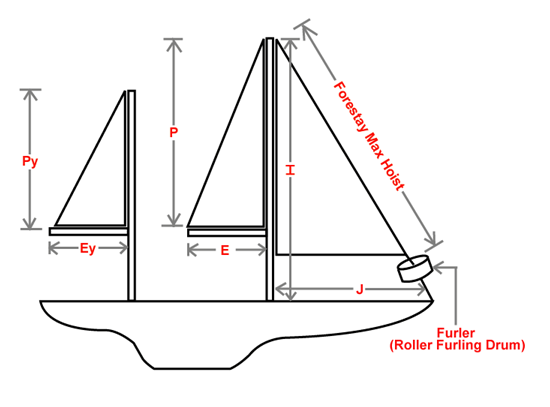
It is fairly easy to figure out how to size a symmetrical spinnaker. Specifically, the leech / luff length of a symmetrical spinnaker should be about the same length as the I of the boat and no smaller than 95% of the I.
As far as a pole is concerned, it is recommended that the pole be the J length.
These dimensions I and J are standard measurements usually published in the owner’s manual. You can also consult sailboatdata.com which is an excellent source for boat data.
Can’t find it? Contact us using the form at the bottom of this page so we can work with you.
Once you have the I of your boat, consult the symmetrical spinnaker dimensions page to see what standard symmetrical size you would need in our range.
If you fall in between, we can easily adapt, so contact us.
Basically:
- I is measured along the front of mast from the halyard to the main deck. The main deck is where the deck would be if there were no deckhouse.
2. Asymmetrical spinnaker sizing
If you can access your boat = most accurate
We only need one measurement to calculate the spinnaker size you need. We need to know the space available on your boat, because your boat is unique.
The space available to install an asymmetrical spinnaker on your boat is measured in a straight line from the halyard block (technically the bearing surface of the tackle) down to the tack attachment point, (technically again, the bearing surface of the tack line shackle).
If you can access your boat, we recommend measuring it rather than relying on an estimate, as an actual measurement of your boat is more reliable than a generic boat-model database lookup.
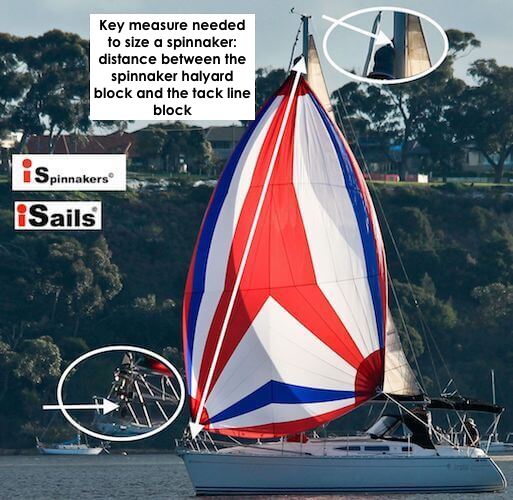
Curious to know why this measurement matters? Well, for an asymmetrical spinnaker, the goal is to have the right luff length.
The luff of a spinnaker sized right will assume the intended curve while the sail is fully hoisted, with the tack reasonably close to the deck.
If the spinnaker is too small, you will have to trim the luff too tight, or let the tack fly too high. If the spinnaker is too large / long in the luff, you will not be able to trim it right for reaching / tight reaching.However, you cannot measure a luff length directly. To figure out the right luff length, we derive it from the space available to install a spinnaker as measured on your boat from the halyard block (technically the bearing surface of the tackle) down to the tack attachment point, (technically again, the bearing surface of the tack line shackle).
This space available to install a spinnaker is often called the “Max Hoist”.
The spinnaker itself is designed to fit the available space on the boat.
This is the most reliable way to determine the asymmetrical spinnaker you need because it measures your actual boat and your actual rig configuration.
How do you do that?
To measure, just hoist a measuring tape on your spinnaker halyard; and measure down to the point where you will attach the block for the tack line of the spinnaker.
If you do not have a tape long enough that you could hoist and measure directly, just hoist a non-stretch rope on the spinnaker halyard, and mark it with the tack position. Then take the rope down and measure the rope on the ground between the end that was attached to the halyard and the point you marked.
* Here is a little tip: if you measure with a tape, attach a thin line to the spinnaker halyard along with the tape: if the tape should break, the line will let you bring the halyard back down without having to climb the mast to get the halyard back….
Then compare the space you have on the boat to the space our spinnakers need to get a first estimate of the size you need.
Deciding on the dimensions and size of your cruising spinnaker can also be specific to your navigation circumstances or preferences, if your mast has been updated, if you have sprit, will use a sock or a furler, etc.
If you do not have access to the boat = get a good estimate
You can use public databases and our starter tool by brand to estimate the size you need.
Navigate to the find your boat page, or use the main menu to get to your specific brand / shipyard.
Once you find your boat model, this table provides a first estimate of the spinnaker size recommended in our standard cut spinnaker range. Then follow the link to the detailed dimensions page, or to the spinnaker store.
Just know that we will always check these with you before placing your order with the factory.
Databases give us a starting point; our expertise tells us whether that starting point makes sense.
Why the boat configuration matters: using a spinnaker sleeve, a furler, or a sprit
We said earlier that the important number is the space available between the spinnaker halyard exit and the tack point on your boat. If you use a spinnaker sock, a furler, or a sprit, these come into play in the calculation of the spinnaker size as there will be “less” or “more” space available to fit your spinnaker. Depending on your boat, you may need a smaller standard size or a custom size (usually for sprits).
A couple of things to keep in mind:
- if you are going to use a sock, the head of the sail will be shackled to the bottom of the sock built-in cable/swivel hardware, rather than to the halyard shackle – the length of this cable needs to be deducted from the distance available to install a spinnaker / max hoist. We can calculate this for you.
- if you are planning to use a top down furler, you need similarly to deduct from the max hoist the length of the bottom and top fixtures to which the spinnaker will be mounted.
- if the spinnaker is set on a bow sprit, rather than at the bow, you need to add to the estimated max hoist, because you will need to be able to bring the tack tight down to the end of the bow sprit (you can not do that if the tack is at the bow, because this would cause too much wear and tear against the pulpit).
3. sizing a custom or racing spinnaker
For modified rigs, for modern catamaran masts set way back on the boat, for bowsprits, or for racing programs, we will likely design a custom spinnaker if necessary. We will need at minimum the I and J to design a custom size / shape spinnaker. Ideally, we will want to measure:
- how far are the spinnaker sheet lead blocks from the tack of the sail (for an asymmetric) ; or from the bow (for a symmetric)
- how far from the boat media axis are the sheet lead blocks
Use the contact form below for more information.