

Choosing a downwind sail is about more than price.
You’ve talked to us, consulted your local sailmaker, checked sailmakers online, compared quotes—and perhaps even looked at used spinnakers and Code Zeros.
Now you have a few options you like. Now comes time to choose.
First, are you really comparing equivalent sails?
When you receive several quotes for what appears to be the same sail, it’s tempting to compare the prices and assume you’re comparing equivalent products.
But two sails that look similar on paper may not actually be comparable. Three important factors can influence both the quality and the price of a sail:
1. The sail area matters.
A quote is only meaningful if you’re comparing sails of comparable size, as one way to make a sail appear less expensive is simply to quote a smaller sail. But a smaller sail isn’t necessarily a better deal. It may simply provide less sail area—and therefore less power and performance in the conditions for which you wanted the sail.
So when comparing prices, first make sure you’re comparing comparable sail areas.
2. The cloth matters.
Sailcloth isn’t all the same. Different cloths vary in construction, weight, durability, stretch resistance and manufacturing origin—and these differences can have a significant impact on price.
Cloth also represents a significant part of the cost of a sail.
That means two sails with similar dimensions can have noticeably different prices simply because they use different grades or types of cloth.
A lower-priced quote doesn’t necessarily mean you’ve found a better deal. You may simply be comparing different materials.
3. Construction matters, too.
The number and arrangement of panels used to build a sail can affect how accurately the sailmaker can control its shape and manage loads throughout the sail.
More panels can allow for more precise shaping and load distribution. They also mean more cutting, sewing and assembly—and therefore more labor.
Panel count is another factor that can influence both the construction and the price of a sail.
So when comparing quotes, don’t just ask: “How much does the sail cost?”
Ask: “What exactly am I getting for that price?”
- Are the sails comparable in size?
- Are they using comparable cloth?
- Are they built to a comparable level of construction?
You may not be comparing the same sail at all.
Second, who should you trust to get this sail right for your boat?
A downwind sail is a significant investment. And while price matters, it isn’t the only thing that determines whether you’ll be happy with your sail.
We start with your boat, your sailing and your needs. One of our customers summed up this approach particularly well:
“Finally, someone taking an interest in my boat and not only pushing cloth.”
We couldn’t have said it better.
So here are five reasons sailors choose iSpinnakers / iSails:
1. Downwind sails are what we do.
We specialize in Spinnakers and Code Zeros and genoas, along with the equipment that makes them easier and safer to use, including Seldén furlers and spinnaker socks.
Because this is what we do every day, we’ve gained experience with a wide variety of boats, rigs, sailing styles and conditions.
We use that experience to help you choose the right sail—not simply the biggest sail or the lowest-priced sail.
Your boat comes first. The sail comes second.
2. You get personal advice—not a one-size-fits-all recommendation.
Every boat is different. And every sailor uses their boat differently.
Does your boat have a bow sprit? What mast does your boat has?
Do you cruise short-handed? Race occasionally? In what conditions do you sail? What AWA do you target? Want to maximize light-air performance? Or is easy handling your priority?
Those details matter.
We take the time to understand your boat and how you sail before recommending a sail.
We’ll discuss the important details with you, answer your questions and explain the options so that you can make an informed decision.
You’re not just buying a sail. You’re getting advice from people who understand downwind sailing. We are building a relationship.
3. We can supply the sail and the sock or furler to retrieve it.
We’re a Seldén distributor, which means we can help you with more than just the sail.
Depending on your boat and your needs, we can supply equipment such as spinnaker socks and Seldén furlers to make your downwind sail easier to handle.
That gives you one knowledgeable source for the sail and the equipment that goes with it.
One conversation. One source. A system designed around your boat.
4. We’re here after the sale, too. We stand behind our products—and our customers.
Our relationship doesn’t end when your sail ships. We’re here to answer questions, help you get the most from your new sail and help when something doesn’t go according to plan.
Sailing can be unpredictable. We’ve had customers experience mishaps shortly after receiving a brand-new spinnaker. When that happens, we do our best to support our customers and help find a solution.
We follow through.
Our sails are covered by a 2-year warranty against manufacturing defects.
When you choose iSpinnakers, you’re choosing a small company that cares about the people we sell to. If something goes wrong, we want to hear about it and we’ll do our best to help.
That’s important when you’re making a significant investment in a sail.
We stand behind what we sell—and we stand behind our customers.
5. Don’t just take our word for it.
We’ve helped sailors with many different boats, rigs and sailing goals find the right downwind sail.
Their experiences are one of the best ways to understand what working with iSpinnakers is actually like.
See customer projects, sailing stories and feed back, examples below:
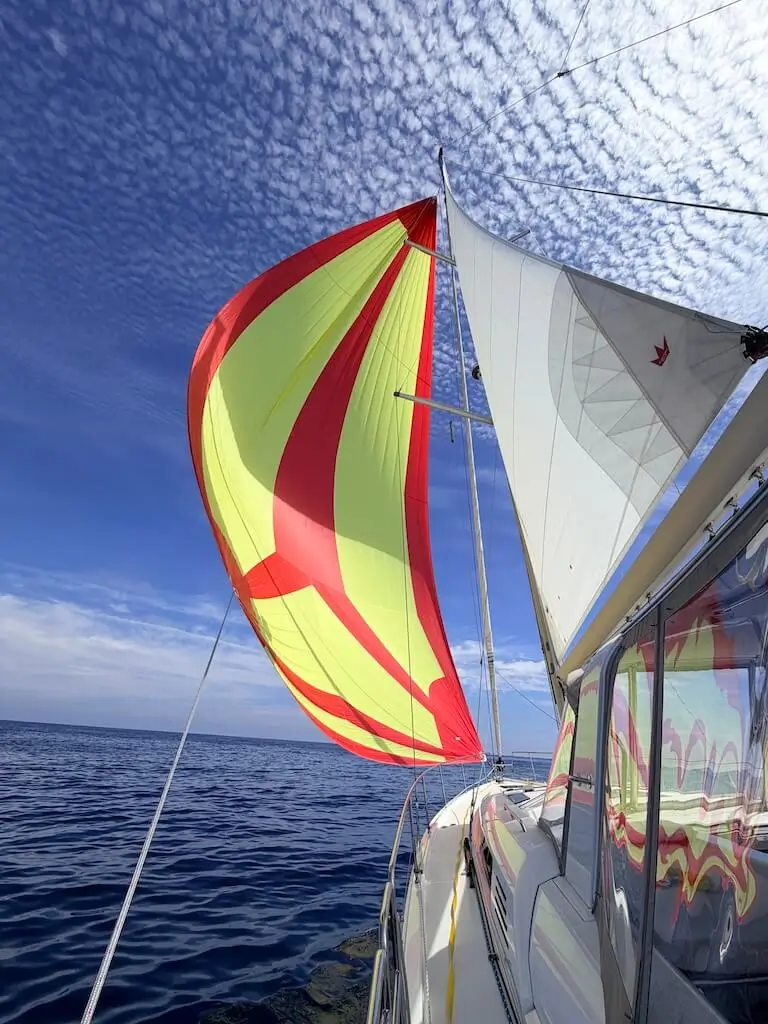
Beneteau Oceanis 51.1
San Diego Coast, USA
Asymmetric Spinnaker
Sail size: 176sqm / 1894 sqft
Luff length: 20.4m / 66.9 ft
Use: cruising
Sail cloth: Contender Maxilite
Retrieval device; Seldén GX 25 top down furler
Set up: outside pulpit
Sailing location: off the San Diego coast, around all nine of the Channel Islands (20-56 miles) off CA.
“I used the spinnaker in five-knot winds, propelling my boat at four knots while maintaining a 135-degree angle to the wind. In stronger winds of twelve knots, the asymmetrical achieved a sailing speed of eight and a half knots.
“I cannot express enough positive remarks about iSpinnakers!”
Photo credit: Doug M.
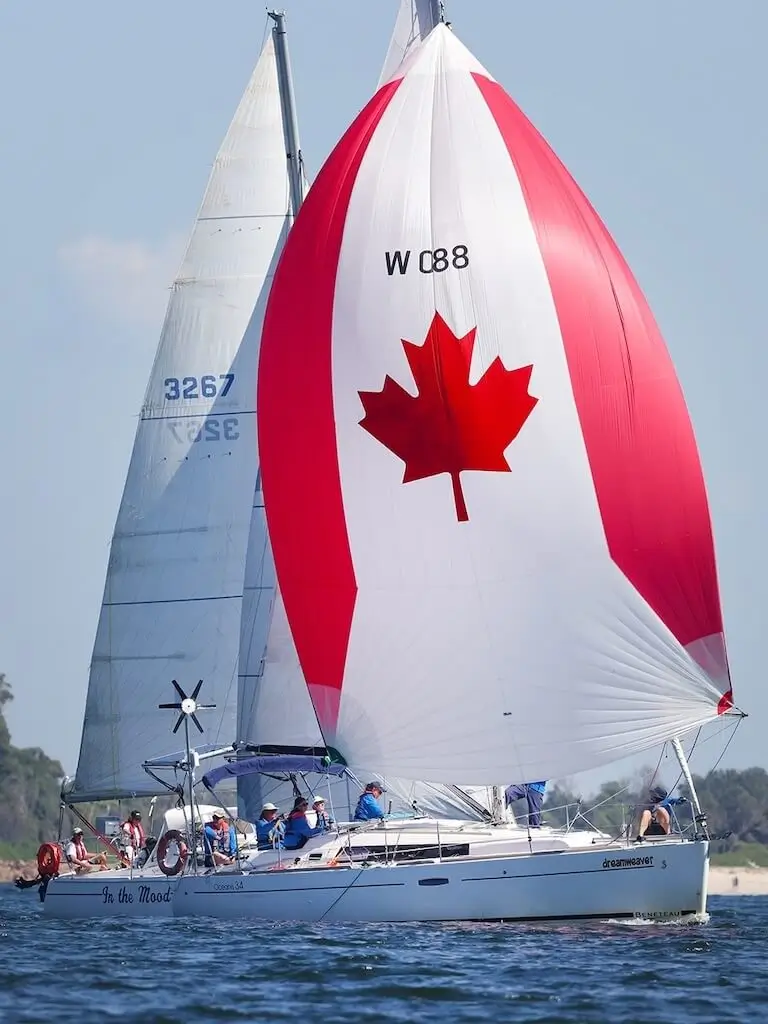
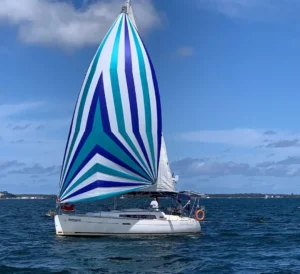
Beneteau Oceanis 34
S/V Dreamweaver, Australia
Symmetric Spinnaker with logo
Sail size: 82 sqm / 882 sqft
Leech length: 12.6m / 41.3ft
Use: performance cruising and racing
Sail cloth: Contender Nylite
Retrieval device: sock
Sailing location: moored in Kilaben Bay, ocean sailing, Australia
“I’ve been racing in Australia off and on since 2012.
We have been cruising in the Whitsundays and Sail Port Stephens regatta. On the photo, we are passing another competitor. About 1 minute earlier we had him covering our spinnaker until we got some clear air as we pushed him to windward.”
Photo credit; Graham H.
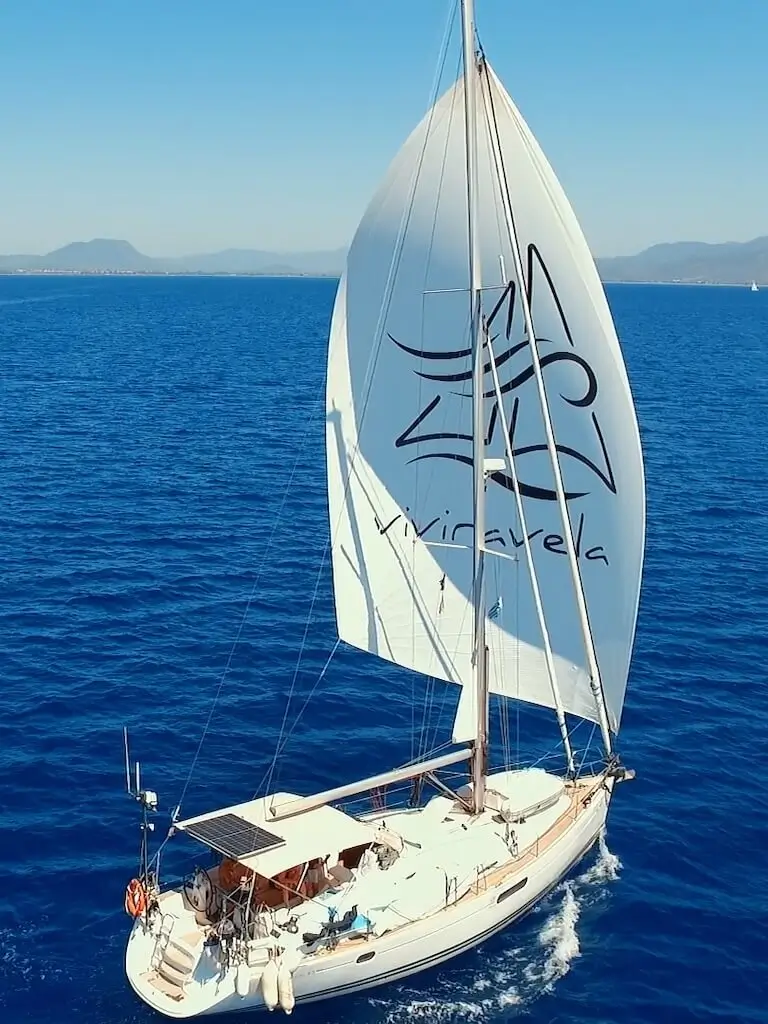
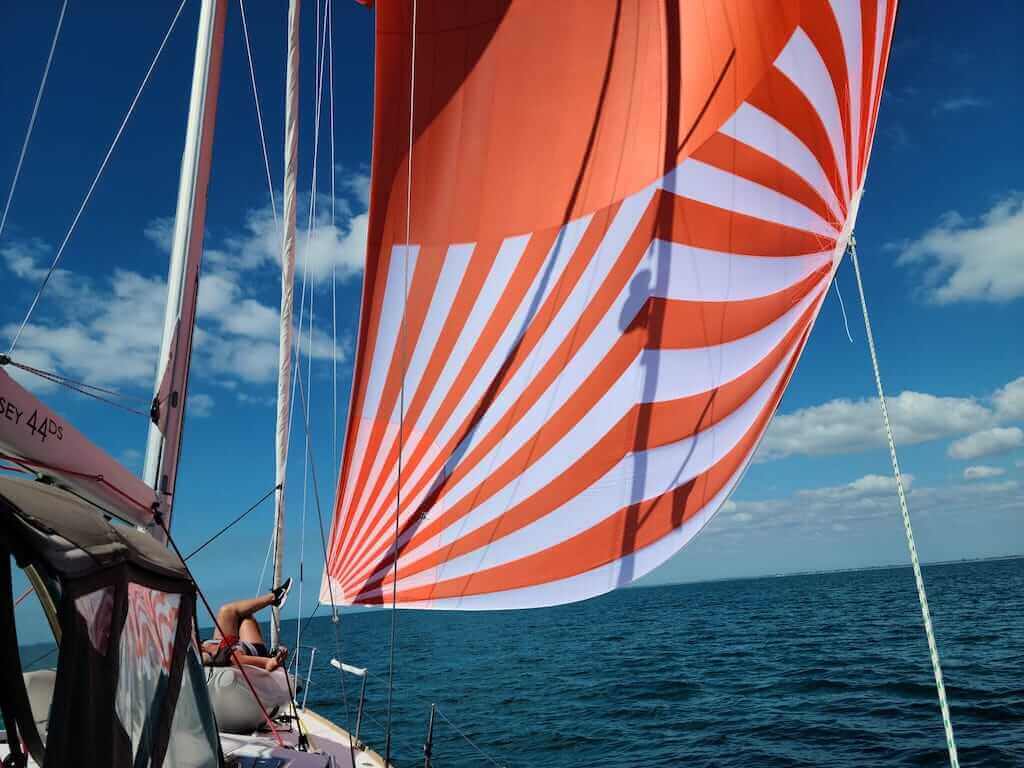
Jeanneau SO 45DS
S/V Viviravela, Spain
Asymmetric spinnaker, with logo
Sail size: 119 sqm / 1280 sqft
Luff length: 16.4m / 54 ft
Use: Cruising the Mediterranean
Sail cloth: Contender Maxilite
Retrieval device: sock
Sailing location: Mediterranean
Sergi and Raquel , as they say, are not a conventional family! They like to move, to change.
Right now, they are sailing around the south of France, Sardinia, Italy, Croatia, Greece ,…
They invite their customers to treat themselves to a few wonderful sailing days onboard Viviravela. Take a few days off and disconnect from the routine! Viviravela site
“We love the sails, they said!
Photo credit: Viviravela
Still comparing quotes?
That’s a good thing.
Just make sure you’re comparing sails and customer approach. Before you make your decision, ask yourself:
- Are the sails comparable in size, cloth and level of construction?
- Who took the time to understand my boat and how I sail?
- And who will still be there after the sale?
If you’d like to talk through your options, tell us about your boat and how you sail. We’ll help you figure out what makes sense for your situation.
Email us or fill in the form below